Beskrivning
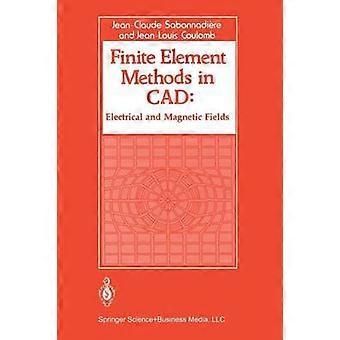
Finite Element Methods in CAD
1 Principles of the finite element method. - 1. 1. Principle equations of mathematical physics. - 1. 2. The idea of a well posed problem. - 1. 3. Integral formulation. - 1. 4. Approximation of the unknown functions. - 1. 5. Minimization of the functional with the aid of approximation functions. - 1. 6. The finite element mesh and the approximation functions. - 2 From one dimension. to three. - 2. 1. Elementary principles of the finite element method. - 2. 2. Example 1: one dimension. - 2. 3. Example 2: two dimensions. - 2. 4. Example 3: three dimensions. - 2. 5. Example 4: problems in the time domain. - 3 Finite elements and approximation functions. - 3. 1. Introduction. - 3. 2. One-dimensional elements. - 3. 3. Two-dimensional elements. - 3. 4. Three-dimensional elements. - 3. 5. Conclusion. - 4 Numerical methods. - 4. 1. Methods for solving systems of linear equations. - 4. 2. Non-linear systems: the Newton-Raphson method. - 4. 3. Numerical methods for calculating definite integrals. - 4. 4. Differential equations with initial conditions. - 4. 5. Conclusion. - 5 General theory of second order isoparametric elements. - 5. 1. Introduction. - 5. 2. Setting up the equations. - 5. 3. Application of the Newton-Raphson method. - 5. 4. Construction of the matrix H and the vectors F and R. - 5. 5. The finite elements. - 5. 6. Application. - 6 General architecture of CAD systems based on the finite element method. - 6. 1. General structure. - 6. 2. The data entry module. - 6. 3. The solver. - 6. 4. Postprocessors. - 6. 5. Architecture of finite element software. - 6. 6. Communication between programs. - 6. 7. Interdisciplinary software. - 6. 8. Conclusion. - 7 Geometry mesh generation and physical properties. - 7. 1. Description of the geometry. - 7. 2. Discretization of the domain. - 7. 3. Description of physical characteristics. - 7. 4. Conclusion. - 8 Postprocessing. - 8. 1. Objectives of postprocessing. - 8. 2. Extraction of information. - 8. 3. Visualization of the information. - 8. 4. Conclusion. - 9 Applications. - 9. 1. The FLUX2D package. - 9. 2. FLUX3D. - 9. 3. Microcomputer software. - 9. 4. The super programs. - Conclusion. Language: English
-
Märke:
Unbranded
-
Kategori:
Utbildning
-
Artist:
Jean Claude Sabonnadiere
-
Format:
Paperback
-
Publiceringsdatum:
2013/10/20
-
Sidantal:
194
-
Förläggare / Bolag:
Springer
-
Språk:
English
-
Fruugo-ID:
450594572-949695993
-
ISBN:
9781468487411
Leverans och returer
Skickas inom 6 dagar
Leverans från Storbritannien.
Vi gör vårt bästa för att säkerställa att produkterna du beställer levereras kompletta och enligt dina specifikationer. Om du däremot skulle ta emot en ofullständig beställning, eller andra artiklar än de du beställt, eller om det finns någon annan anledning till att du inte är nöjd med din beställning, kan du returnera beställningen, eller valfria produkter som ingår i beställningen, och få fullständig ersättning för artiklarna. Visa fullständig returpolicy